Showing posts with label brown ink. Show all posts

Tuesday, January 27, 2015

2014 ink of the year

I know this post is a month late and a few bucks short but better late than never. In my defense, I'm back from a long vacation and it's hard to get the old routine back on track.

Without further ado, I present you my top 3 favorite inks tested in 2014, along with 3 runners-up.

#1 Monteverde Brown

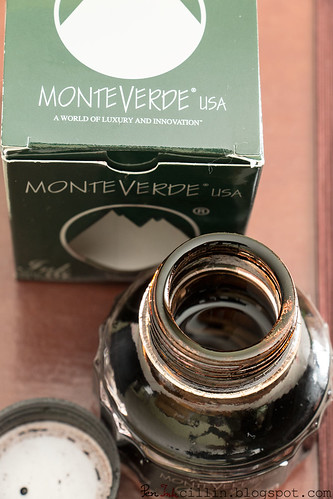
Monteverde Brown is absolutely the ink I enjoyed most in 2014. I just love brown inks and this is the definitive brown.

Monteverde Brown open bottle

#2 Noodler's Black Swan in English Roses

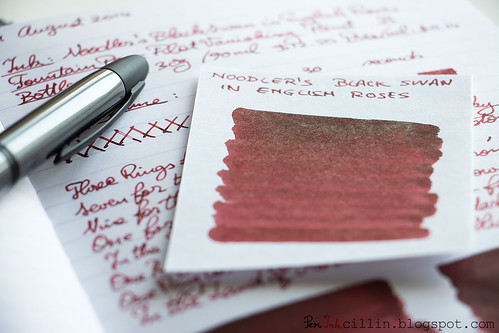
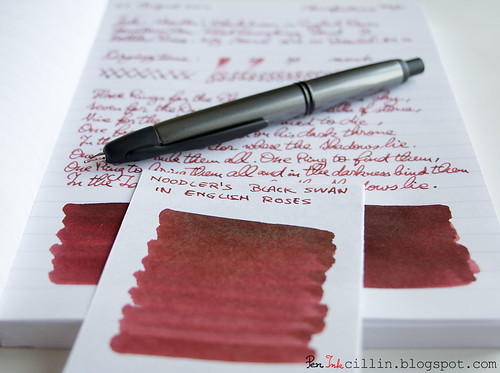
Noodler's Black Swan in English Roses is a close second. I love its burgundy/brown color and beautiful shading.

Noodler's Black Swan in English Roses sheen

#3 Diamine Green Black

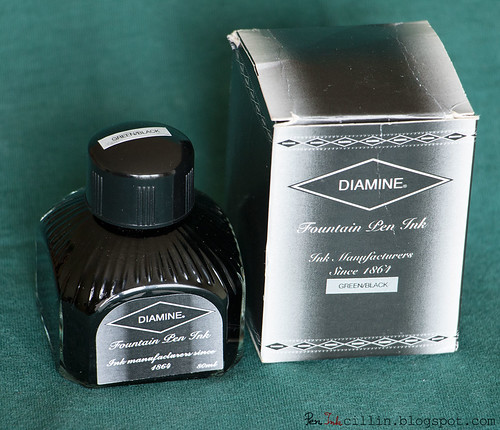
Diamine Green Black is the ink which resembles the color "British racing green" the most. If I were to pick a green ink out of all the ones I've tested (not just in 2014), this would be it.

Diamine Green Black bottle

Runner Up #1 - Diamine Graphite

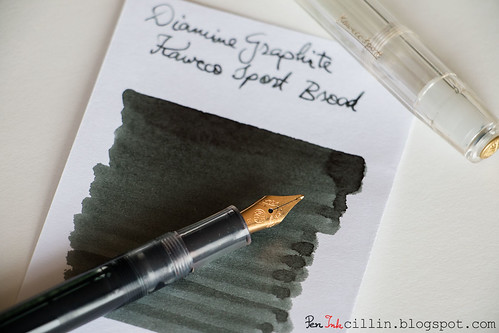
Normally I'm not a fan of gray inks because they're too boring, but Diamine Graphite changed my mind. It proves that a gray ink can be engineered well enough to make it useful in a professional setting and look good at the same time.

Diamine Graphite and Kaweco Sport

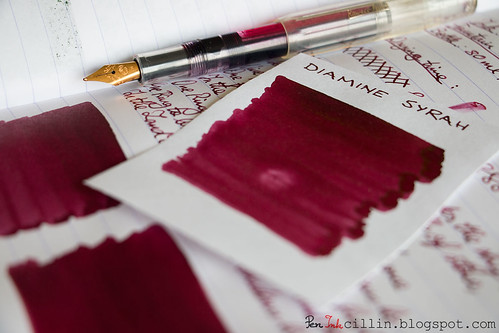
Runner Up #2 - Diamine Syrah

Diamine Syrah is an ink I love to hate. The color and shading are gorgeous and hard to beat. However, it likes to stain plastic and smears on glossy paper.

Diamine Syrah shading

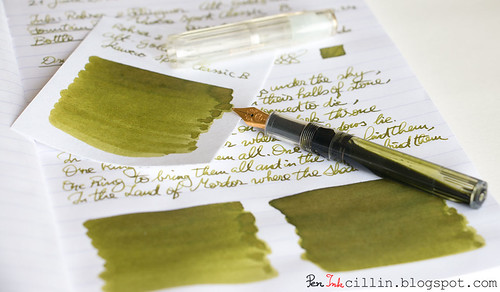
Runner Up #3 - Rohrer & Klingner Alt-Goldgrun

Rohrer & Klingner Alt-Goldgrun is a wonderful shade of bright, saturated olive green with beautiful shading. R&K inks are a bit quirky though and flawed in other aspects, such as feathering and sometimes flow.

Rohrer & Klingner Alt-Goldgrun with Kaweco Sport

Tuesday, December 2, 2014

Noodler's Whaleman's Sepia ink review

Manjiro Nakahama Whaleman's Sepia is a special ink from Noodler's, in that there's an interesting story behind it, it comes only in 4.5 oz bottles which include a free pen, it has a peculiar scent, and the color is rather unique. One more, very important detail, is that this is one of Noodler's security inks, meaning that it was designed to be tamper proof, including high resistance to agents such as bleach.

The name Manjiro Nakahama comes courtesy of a Japanese gentleman who was really into ships and such. Follow the link under his name if you want to find out more but I won't bore you with the details.

In a nutshell, Whaleman's Sepia was designed to resemble the inks that old-time whalers used to make out of squid ink. Very cool concept. I wish it were actually made from squid ink.

I've been waiting a long time to review this ink and here it is, finally. Was it worth the wait? Methinks not, but read on to find out why.

I tested a sample of this ink in my Pilot Vanishing Point with broad nib.

Bottle and pricing

Bottle capacity: 4.5 oz / 133 ml
Price: $27.50 (+ free pen)
Price / ml: $0.20

Whaleman's Sepia is a tad pricier than regular Noodler's inks but not by much and it does come with a pen (an eyedropper Platinum Preppy). You're out of luck if you don't need so much of it though, because it doesn't come in smaller bottles.

Quick word about the peculiar smell. While pungent, I don't find it unpleasant at all. It doesn't stink outright, but you will definitely feel it if you put your nose to the bottle/vial.

Color and saturation

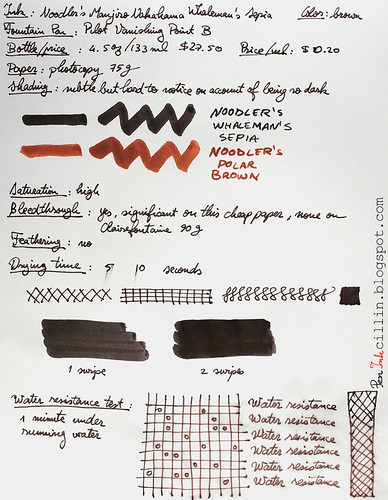
Whaleman's Sepia is supposed to be a sepia-colored ink, which is a shade of brown. It has high saturation but the main problem (for me) is that it comes very close to black as opposed to brown. To my eyes, on paper, it looks positively black. What's interesting is that the photos managed to capture the brown better than my eyes can distinguish it.

Speaking of photos, this is the first ink review where I'm using a new camera to shoot the ink samples.

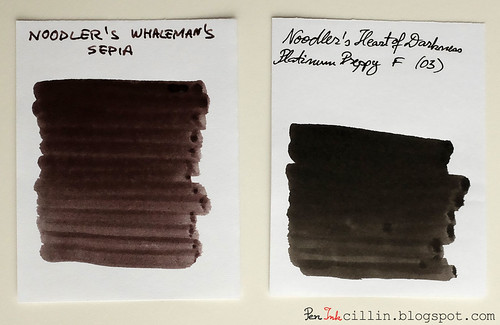
Back to the ink, in the copy paper example there's a comparison with a regular brown ink, Noodler's Polar Brown. The differences between them couldn't be greater. Just for a lark, I decided to compare it to Noodler's Heart of Darkness (below) and it's obvious how much more it resembles a black ink than a brown one.

Noodler's Whaleman's Sepia vs HOD

Shading

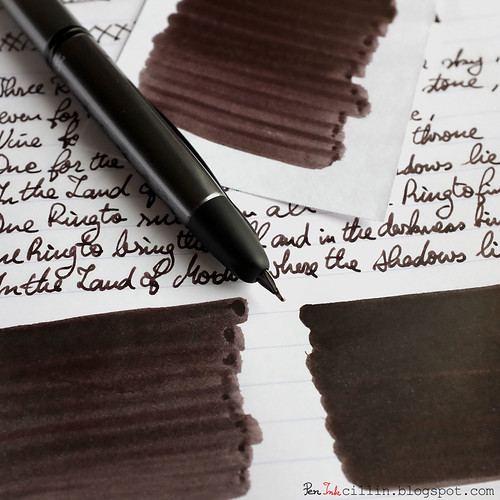
I could say there's none, but if I peer closely into its murky darkness, there are slight variations, so for the sake of brevity I will admit that there is some color variation.

Noodler's Whaleman's Sepia shading

Feathering

None.

Bleedthrough

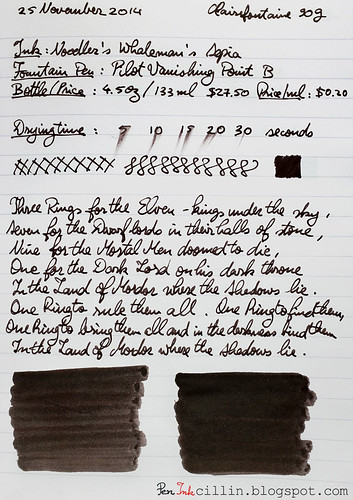
Obviously, such a dark ink will bleed on cheap paper. On Clairefontaine 90g it doesn't.

Flow, lubrication, and smoothness

The crux of my beef with Noodler's Whaleman's Sepia is that it is a very dry ink, and I don't like this type at all. Folks with free-flowing nibs might enjoy it though, but it doesn't work for me. The Pilot Vanishing Point struggles with it and the nib dries up after every use. Once it gets going, it writes smoothly enough - when it doesn't skip - and it likes to do that a lot. Unfortunately I've been forced to pump the pen's converter pretty often, to get it going.

Drying time

Drying time is longish on smooth paper but fairly short on photocopy. Nothing out of the ordinary.

Smearing when dry

Surprisingly, this ink doesn't smear much, even on Clairefontaine, provided it dries well. I would have expected it to smear but apparently it bonds really well with the cellulose in the paper. That's very good, but don't forget this is a security ink, meaning that smear resistance should come with the territory.

Water resistance

Water resistance is 9-9.5/10. It's not perfect because a very thin layer washes off after exposure to water, but I don't see that as an issue.

One thing that I didn't test and I would like to find the time for, is bleach resistance. The documentation states that the ink changes color from brown to red to purple, the stronger the bleach. Hopefully I can test that soon.

Conclusion

Sadly I'm not a fan of Noodler's Manjiro Nakahama Whaleman's Sepia. I love the lore behind this ink and the intent, but the color is too dark (though I'm sure for others this is a boon), and worst of all it writes too dry for comfort. Furthermore, unless you need tons of it, you won't find it in smaller bottles. I would give this one a pass, but if you are a fan, please share your experience, I'd love to hear about it.

Here are the two samples, on photocopy and Clairefontaine 90g, respectively.

Noodler's Whaleman's Sepia on photocopy

Noodler's Whaleman's Sepia on Clairefontaine

Wednesday, August 13, 2014

Noodler's Black Swan in English Roses ink review

With my recent reviews of burgundy inks - Diamine Syrah and Noodler's Black Swan in Australian Roses - I thought it might be fitting to end this "series" by reviewing the other ink in Noodler's Black Swan family, English Roses.

Noodler's Black Swan in English Roses (BSER) is a bit of a departure from strict burgundy, but it's close enough that I can put it in this category.

I reviewed this ink in my Pilot Vanishing Point with broad nib, same as its Australian sister. The VP really helps bring out the qualities in the ink.

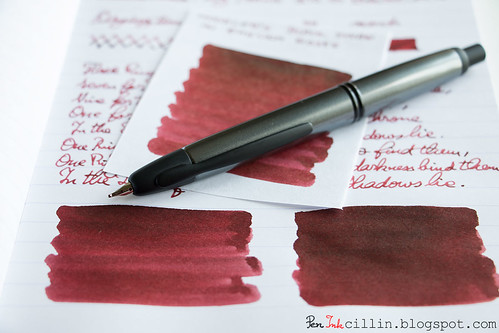
Noodler's Black Swan in English Roses shading


Bottle and pricing

I didn't have a whole bottle of BSER, just a sample. But a 3 oz / 90 ml bottle will set you back $12.50, same as most Noodler's inks. That amounts to $0.14 per milliliter. Dirt cheap!

Color and saturation

While Noodler's Black Swan in English Roses is still a shade of burgundy, it's definitely more brown than Australian Roses. The original formula of Australian Roses was redder, while the new formula is apparently purplish. But English Roses leans towards brown. In fact, the first thought that came to my mind when I saw it on paper was that it looks like dried blood.

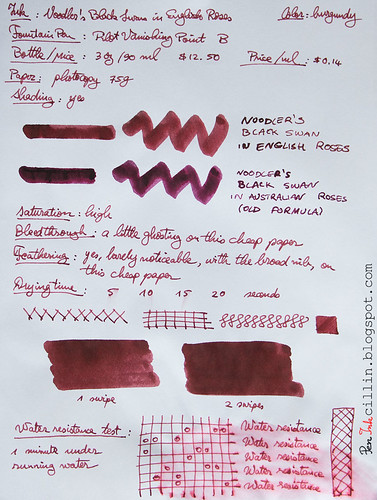
Saturation is high.

Noodler's Black Swan in English Roses writing

Initially I didn't like it much, after just having transitioned from Australian Roses, but it quickly grew on me. Now, I'd say it's a wash between the two. It may be that I slightly prefer English Roses over the original formula Australian Roses.

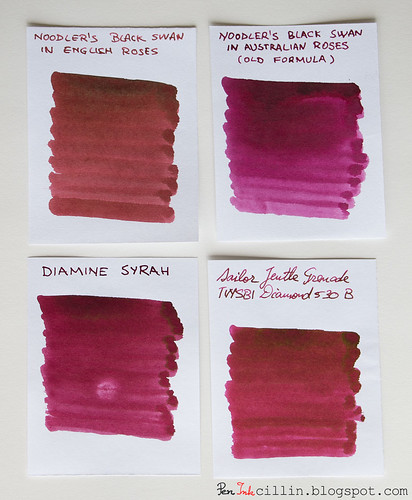
Here's a comparison between English Roses, Australian Roses (original formula), Diamine Syrah, and Sailor Jentle Grenade (discontinued). Notice how brown Enlish Roses looks compared to the others.

Noodler's Black Swan in English Roses vs Australian Roses vs Diamine Syrah vs Sailor Jentle Grenade

Shading

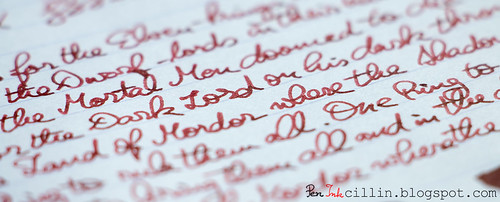
English Roses is very pleasing shade-wise. The line variation with the Pilot Vanishing Point's broad nib is outstanding, and it confers a lot of personality to the ink. The springiness of the nib helps bring out this character even more.

Noodler's Black Swan in English Roses shading

Sometimes shading is complemented by sheen, and I'm happy to note that, under the right light, Noodler's Black Swan in English Roses shows some interesting golden sheen, almost (but not quite) in the vein of J Herbin 1670 Rouge Hematite. Don't get your hopes too high though, because this is hard to spot in written lines, but it can be seen in the q-tip swab.

Noodler's Black Swan in English Roses sheen

Feathering

There is a little bit of feathering on cheap photocopy paper unfortunately, but it's probably due in part to the high saturation of the ink, as well as the broad nib. It's nothing to worry about, especially since it's a non-issue on better paper.

Bleedthrough

Black Swan in English Roses will produce a little show-through (but not excessively so) on cheap paper, since, I re-iterate, it's a dark and saturated ink, and it was tested with a broad, wet nib. On Clairefontaine that's not an issue.

Flow, lubrication, and smoothness

I am extremely pleased with how Noodler's Black Swan in English Roses flows in my Pilot Vanishing Point. It is wet and very smooth, just the way I like it. Apart from that, there's nothing else to say, except maybe that it didn't dry once from non-use, despite using the pen briefly once a day. I guess that's also a testament to how good the VP is.

Drying time

Wet, saturated inks will usually have longer drying times and so is the case here. On cheap paper it can take up to 15-20 seconds to dry, with the broad nib, while on Clairefontaine that time can stretch beyond 30 seconds. That is a bit of a problem because one of the things I do with this ink and the Pilot VP is to jot down journal notes in a Clairefontaine 90g notebook. I have to be careful to let it dry thoroughly before I turn the page.

Smearing when dry

Surprisingly, despite the darkness and saturation, English Roses doesn't really smear, even on smooth, glossy Clairefontaine paper, provided enough drying time is allowed. That's in sharp contrast to Diamine Syrah which does smear. In fairness, if I rub it really hard, I can see just a little bit rubbing off but not if I casually touch the text with my skin. I suspect this resistance to smearing is partly due to its water resistance.

Water resistance

The inks in this family are water resistant and so is English Roses. Not completely, as you can see from the sample, but plenty, such that you won't lose valuable notes if you get them wet. A little dye does get washed away though.

Conclusion

I started out being a little "meh" about Noodler's Black Swan in English Roses but as I used it more and more, it quickly grew on me, to the point where I can confidently state that I like it a lot, perhaps even more than Australian Roses. Imagine a saturated, brown-leaning, water resistant burgundy ink with great flow and exquisite shading, and that would be a good description for Noodler's Black Swan in English Roses. If you can load it in an awesome pen like the Pilot Vanishing Point, even better. My recommendation is to buy yourself a bottle (if you like the color) while the current formula is still being made.

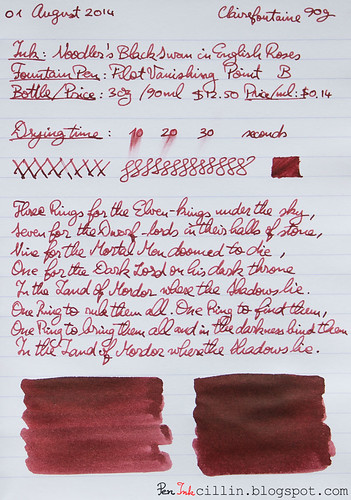
Here are the two samples, on photocopy 75g and Clairefontaine 90g paper, respectively.

Noodler's Black Swan in English Roses on photocopy

Noodler's Black Swan in English Roses on Clairefontaine

Wednesday, February 19, 2014

Monteverde Brown ink review and GIVEAWAY

As fate would have it, Jetpens were kind enough to send me another ink for review. This time I opted for a brown ink. I can't explain it but I have a weakness for brown inks. Maybe because I love chocolate, brown leather boots and my brown cargo pants. For the first time I'm also reviewing a Monteverde ink. I won't spoil it too much but suffice to say that it's a very good first impression. Read on to find out why Monteverde Brown is a pretty cool ink.

Oh and in the meantime, if you wish, you can subscribe to my Twitter, @Peninkcillin.

Monteverde Brown bottle on box

THE GIVEAWAY
Jetpens is offering a bottle of Monteverde Brown exclusively to my readers. Head on to their giveaway page for a chance to win. NOTE: you will need to subscribe (or already be a subscriber) to Jetpens' newsletter before you can submit your entry for the giveaway. For existing subscribers, just enter your email and hit "Submit". If you are not already a subscriber there's a handy "Subscribe to our newsletter" box on the bottom right side. The giveaway runs from the time this review is posted until 02/26 11:59PM PST. Good luck!

Monteverde Brown open bottle
Now before I start, a quick side note about Monteverde. The company is pretty much a mystery to me but it seems it is US-based. At least that's what it says on the box, Monteverde USA. On their site they claim that materials used for their pens are sourced from Europe. I've long been interested in their fountain pen line and hopefully one day I'll get to review one.


One more thing about this ink. Monteverde claims their inks have ITF (ink treatment formula), which, I quote:
"- Drastically improves ink-flow quality.
- Extends cap-off time.
- Lubricates and protects the ink-feeding systems from corrosion and clogging.
- Improves ink-drying time on paper."
We shall find out if these claims are supported.

The writing samples in this review were done with my Lamy AL-Star, mainly with the EF nib but also with the 1.1mm, 1.5mm, and 1.9mm italics.


Bottle and pricing
There's nothing special about Monteverde ink bottles, though I am rather partial to the particular shade of green they chose to use for the box and label. The box itself has a window in the shape of the stylized Monteverde logo through which either the bottle can be seen, or a card/label in the color of the ink. I didn't photograph the card because it was ink-stained. Jetpens sells this ink for $12.50. A bottle holds 9ml / 3 oz, which makes it $0.14 per milliliter. That's one of the most inexpensive inks you can buy.

Monteverde Brown box & bottle

Color and saturation
Monteverde Brown is a fairly neutral, well, brown. It does have some red in it but I like it that way because it looks warmer. It is also fairly saturated. To get a better idea of the particular shade of color, I placed this ink next to 3 others that I had samples of. Here's how Monteverde Brown compares to Noodler's Polar Brown, Waterman Havana Brown and Noodler's #41 Brown.

Monteverde Brown 4 ink comparison

As you can see, the two Noodler's inks are similar and darker, tending towards black. Waterman Havana is more reddish but also colder in appearance. It drifts into burgundy territory. Monteverde Brown seems just right: warm and with just the perfect ratio of red to black. In a word, it's chocolaty.

Switching to my Noodler's Ahab flex pen, which I admit wasn't very expertly adjusted, the very wet flow produced almost black text. You can see this in the Clairefontaine sample below.

Monteverde Brown on Clairefontaine

Just for fun I thought I would take a shot of the three q-tips I used to sample Monteverde Brown, Noodler's Polar Brown, and Waterman Havana Brown, after they were laid on tissue paper. It's fascinating to see how the ink sometimes breaks up into its components when it's absorbed into the paper. As you can see, Monteverde is pretty consistent, there isn't much breakup there. Polar Brown, on the other hand, shows a surprising amount of orange, while Waterman Havana is also dark brown but with reddish tints.

Monteverde Brown qtip comparison

Shading
I just love me a shading ink, and Monteverde Brown fails to disappoint. Shading + brown = win. As soon as I laid the first stroke after filling my Lamy AL-Star I exclaimed "Wow!". In fact I felt compelled to write that down in my review sample. This ink has very nice shading which can be clearly discerned even with the European-EF nib I had in the Lamy. You may have noticed on the Clairefontaine sample that switching to an italic nib reveals the shading even more. Even the brown-black text written with the Ahab shows a little shading.

Monteverde Brown shading

Feathering
I didn't notice any feathering, except where the J Herbin glass dip pen was used, but that falls within normal parameters considering the cheap paper.

Bleedthrough
Bleedthrough is not an issue with Monteverde Brown, however it ghosts a little on cheap paper, but that's only to be expected of a dark ink.

Flow, lubrication, and smoothness
Two other traits that I highly value in an ink are smoothness and flow. I prefer my inks to flow wet. Monteverde Brown satisfies in no small measure and I would give it a 7/10, perhaps even 8/10 for wetness.

Did I say I also liked smoothness? Oh boy, this ink feels smooth as silk. It really is a pleasure to write with. Even while typing this review I found myself picking up the Lamy and just randomly scribbling something on paper. All this despite the fact that the EF nib in my Lamy is a tiny bit scratchy. Yet, the scratchiness seems to be gone with Monteverde's ink.

Drying time
Drying times in general vary depending on the quality of the paper. There's very little exception here. On photocopy paper Monteverde Brown dries somewhere after the 5-second mark. On Rhodia 80g, however, it takes considerably longer. Because this paper is so glossy, even after 40 seconds it still wasn't completely dry. Of course this is also dependent on how wet your pen writes. For drier nibs this may not be the case, so your mileage may vary.

One additional thing I'd like to mention here is that if you plan to use, say, a flex nib on high quality paper, like I did on Clairefontaine, you will most likely need to let it rest for a very long time before it dries completely, due to the heavy layer of ink that will be deposited.

Smearing when dry
None, but you really gotta let it dry before you try anything, doubly so on very high quality paper. On cheap paper, not so much, it dries fast and it is absorbed quickly by the paper.

Water resistance
Water resistance is not on the list of features for this ink so you can't expect any. As you can see from the sample below, 30 seconds under running water (in fact even less) completely obliterates my testing grid.

Conclusion
It looks like Monteverde nailed it with their brown ink. I honestly didn't know what to expect from this brand, especially since I could swear I hadn't heard of them a few years ago. The ITF (ink treatment formula) claims don't seem 100% supported because the ink's drying time depends a lot on the paper used but I don't find that a big deal, especially considering that it does seem to keep writing even after I've uncapped my pen for about 10 minutes.

Monteverde Brown has quickly become one of my favorite brown inks (perhaps even trumping Waterman Havana Brown) thanks to its combination of beautiful color and shading, incredible smoothness, and great flow. As far as I'm concerned, Monteverde Brown gets as close to brown ink Nirvana as can be. I highly recommend it, and who knows, if you are the lucky one you might just win yourself a bottle of it courtesy of Jetpens.

Monteverde Brown on photocopy

Monteverde Brown on Rhodia

Monday, January 30, 2012

Noodler's #41 Brown ink review

Noodler's #41 Brown is the first brown ink I wanted to buy a long time ago, but because it wasn't in stock at the time, I ended up with Polar Brown. It turns out that these two inks are so similar that they could be identical twins which only their mother can tell apart.

The main features of #41 are that it is a rich, dense brown and it is also bulletproof, which includes resistance to water and substances that forgers might use.

Because this ink and Polar Brown are almost identical in aspect, I won't go into a lot of detail but I will mention the small differences I've noticed.

I only bought a sample of #41 and I tested it in my Jinhao X750 with a broad nib.

Bottle
#41 Brown comes only in Noodler's 3oz (90ml) bottles which cost $12.50 or $0.14 per milliliter. That makes it very affordable.

Color and saturation
#41 Brown is a rich, dark, as well as saturated, brown. If the nib is very thin or if the ink pools a little, you could mistake it for black. Compared to Polar Brown I believe I detect a little bit of neutrality. Polar Brown seems warmer in tone, when analyzing the q-tip color swabs.

Shading
There is very little shading and it becomes apparent only when using a thick swab or a broad nib. Because the ink is so dark don't expect the shading to show itself very often.

Feathering
I didn't notice any feathering, either on Rhodia or cheap paper.

Bleedthrough
Same as with Polar Brown, #41 doesn't normally bleed through paper but if you lay it thick enough, the red component of the ink starts to show through.

Flow and lubrication
One thing that I didn't like about this ink is that it felt dry in the Jinhao. I don't want to generalize and say that many of Noodler's bulletproof inks behave similarly but this is how I feel. Often I had to coax the ink until it started to flow well, but then again, it might be the Jinhao's fault.

Drying time
Drying time was very good on photocopier paper which is more absorbent, but less so on Rhodia where it took between 15 and 20 seconds for the ink to dry safely. From my experience, inks that dry quickly sometimes also bleed through the paper a little, so it's a trade-off you have to consider.

Smearing when dry
The thing that bugs me most about Noodler's Polar Brown is that, if you touch it with your finger or hand, it smears, even after it has had time to dry up. Come back a few weeks, or even months later after you've written something, rub it hard with your finger and the ink will get smudged. That isn't something I like, not when using this ink in a personal journal with 90g Clairefontaine paper.

The better quality the paper, the higher the smearing problem becomes, unfortunately.

I'm afraid that #41 Brown also smears. The good news is that it does it to a lesser extent. On regular, photocopy paper I had to rub it very hard indeed to see a little amount of smearing, while on Rhodia it performed slightly better than Polar Brown.

Smearing can be attenuated or even eliminated if you decide to dilute the ink a bit in water, at the loss of some saturation and darkness.

Water resistance
Since this ink is classified as "bulletproof" there are no surprises here. It is completely impervious to water. My water resistance test is done by holding the sample for a set time (>1 minute in this case) under running water. You will notice that... there isn't anything to notice. You can't even tell that the paper was submerged.

Conclusion
Noodler's #41 Brown is another solid ink from Noodler's, incredibly similar to Polar Brown. The differences between the two are very subtle but essentially they amount to Polar Brown being resistant to cold (useful for keeping a fountain pen in your car in winter) and #41 being slightly less prone to smearing. If you don't need cold resistance you could go for #41. Because it is dark and somber, this ink can definitely be used in a business setting. Also because it is so dark, it can be diluted to a big extent with water, greatly increasing its capacity in the process. Noodler's #41 Brown is not perfect but it is probably one of the best dark brown inks you will find.

Here are the two samples I wrote with my Jinhao X750 (broad nib) on photocopier and Rhodia paper, respectively.

Noodler's #41 Brown

Noodler's #41 Brown on Rhodia

Tuesday, November 15, 2011

Waterman Havana Brown ink review

Havana Brown is the first ink under the Waterman brand that I have tested. Though the brand name might suggest otherwise, apparently Waterman is a French company. Also, on the bottle and box there is no mention of "Havana Brown" per se, just Encre Havane and Havana Ink.

I was so intrigued by this ink (for whatever reason) that I bought a full bottle, based only on what I read in a couple of reviews. I needed a more "playful" brown than my Noodler's Polar Brown and this seemed to fit the bill. In retrospect, I don't regret buying an entire bottle at all. This ink really is a lot of fun. Read on to hear why, but before you do, please bear in mind that what I stated in my writing sample is no longer 100% true. Since then, I've had the chance to play some more with this ink, in a couple more pens, and I have become more acquainted with its characteristics.

Bottle
Waterman has a fairly limited range of bottled inks, about 6-7 of them. I paid $8.64 for my 50ml/1.7oz bottle which gives a price per milliliter of $0.17. Not bad at all. Certainly comparable to Noodler's or Diamine.

Waterman Havana Brown


Color and saturation
Havana Brown is fairly saturated and to me that's a good thing. I like bold, saturated inks. The color is very interesting. Here I will reference Noodler's Polar Brown again because it's the only other brown ink that I have tested which comes close to this one. Well, I have also tested Noodler's Burma Road Brown but that one is an entirely different beast.

If you think of the color "brown" as a mixture of red and black, Polar Brown comes out as more earthy, with a lot more black in it. It is thicker and darker. Havana Brown, on the other hand, shows more red and even tends a bit towards burgundy, thus being lighter in contrast.

Shading
I wrote my first test with my Kaweco Sport Classic with a broad nib but I was a bit misled when I mentioned that there's only a little bit of shading in Havana Brown. Subsequently I have tested this ink some more in my TWSBI Diamond 530 to which I fitted a broad nib, as well as my new mystery pen which is in fact a Jinhao X750, also with a broad nib. It turns out that Waterman Havana Brown only got better the more I used it. The first time I used it in my Kaweco it flowed a bit dry but that was the pen's fault because the ink hadn't saturated the feed completely and it needed some time to get going. I found that the nib needs to flow wet in order for the beautiful shading to make an appearance.

Truth be told, I haven't tried it with a medium or fine nib but I think it would be a shame not to use this ink in a broader nib. The shading is really nice, with a burgundy base and darker brown shadows. If you look at the large q-tip swabs I did on Rhodia paper, you'll see what I mean.

Feathering
There has been no feathering so far, even on the cheap photocopy paper I tested. The dip pen did produce some but that's understandable considering the amount of ink which oversaturates that low-quality paper.

Bleedthrough
The situation regarding bleedthrough is just as clear-cut: none whatsoever with a regular fountain pen, even with a broad nib. Once again, the dip pen breaks through the flimsy barrier of cheap paper but that's only to be expected. You ain't gonna use a dip pen in day-to-day writing anyway.

Flow and lubrication
It's hard to judge an ink's ability to flow, objectively. It depends on many factors, such as fountain pen used, nib size, filling system and so on. What amazed me is how well this ink flowed in my TWSBI Diamond 530.

Here's the premise. I used Polar Brown in the TWSBI since I first got it, but after I switched from an EF to a B nib, there were flow issues. Perhaps Polar Brown is actually dry flowing with a broad nib. Or maybe the nib itself has some issues. Either way, I decided to switch to Havana Brown, just for fun. What a difference it made! This ink flows incredibly well in the TWSBI. Now I can enjoy that bold nib to its full potential.

I have also used it a little in the new Jinhao X750 where it flowed well and gave a nice, wet line. My impression so far is that Waterman Havana Brown is far from dry, and in fact likes to flow really well even in pens with broad nibs.

Lubrication is even harder to define. I have tried this ink in a cartridge, a piston and a converter. There were no issues. 'Nuff said.

Drying time
For such a well-flowing ink, Waterman Havana Brown dries surprisingly quick, even on the more expensive Rhodia 80g paper. Just make sure you don't rub it before it dries completely.

Smearing when dry
None!

Water resistance
I prefer my inks to be water resistant or, even better, bulletproof. Unfortunately, Waterman Havana Brown is neither, but then again, it isn't intended to be. It is, in fact, quite averse to water, as you can see from my testing sample. Within 10 seconds under running water this ink has almost completely washed off. That makes me a little bit sad because I would have loved to use this ink for more permanent writings. But hey, I guess you can't have it all. To be on the safe side, don't leave your notebooks penned with Havana Brown out in the rain - or don't spill any liquids on them.

As a side-effect, notice the traces of red left behind from the washed-off ink.

Conclusion
Waterman Havana Brown is one of those inks that grows on you with use. I found it both playful and serious. The nice shading gives it reddish as well as dark brown hues but it can still hold its own in a business setting (in my humble opinion) thanks to its dark tones. It likes to flow well in a fountain pen and it won't show through the paper, nor will it feather. While drying time is short, it does suffer from that one little flaw which is a complete lack of water resistance. If you don't need a water resistant ink and you like its other features, I highly recommend Waterman Havana Brown.

Following are two samples written on photopy paper and Rhodia 80g.

Waterman Havana Brown photocopier paper


Waterman Havana Brown Rhodia 80g

Friday, May 27, 2011

Noodler's Burma Road Brown (V-Mail) ink review

I've been quite enthusiastic about the fountain pen inks I've tested so far and that's because all of them have shown overall more positive aspects than negative ones. Noodler's Burma Road Brown is the first ink which has left me disappointed. Before you read too much into this, just bear in mind that this is a purely subjective judgment. This is simply not my kind of ink, but read on to see why.

Burma Road Brown is part of Noodler's V-Mail range of inks, which gives them a somewhat vintage look and feel. My review of North African Violet, the first ink in the V-Mail series that I tried, left me impressed. Burma Road Brown seems to be part of that series in name only, because most of its characteristics are different than its sibling's.

As its name suggests, Noodler's Burma Road Brown is a brown(ish) ink. Here's the first problem though: depending on the paper used, on the light, on the pen, this ink varies in color. To me it looks a lot more like khaki than brown. There are shades of green in it, no doubt about it. It is a dark ink but that also depends on the thickness of the nib and on how thick it is applied.

Before testing this ink I was considering buying an entire bottle, based more on preconceived ideas about its color. I admit I was also influenced by the exotic name, but in other reviews it seemed like Burma Road Brown really had a "dusty road" look to it. I don't see much green in a dusty road though. I'm just glad I ordered a sample instead of a bottle.

In my non-expert opinion, Noodler's Burma Road Brown is best suited for drawing, sketching and art in general. This would allow it to show off some of its shading properties because it does have some color variation but this can't really be experienced with a regular fountain pen ink. I'm sure there are plenty of folks who would like to use this ink for writing because it is formal enough to be used in any office setting or on any official document. To me though, it is simply too dull and the khaki tones don't appeal.

I have used Noodler's Burma Road Brown in my Pilot Prera with M nib. While the Prera is a very well-behaved fountain pen, the ink doesn't do it justice. This is easily the driest ink I have tested. Either that or it has flow issues but I've seen other reviews mentioning its dryness. As a result of this, lines are not always consistent, they break up and stutter. Frequently I have to turn the converter's piston knob to make the nib wetter. If you do like this ink, I recommend a fountain pen which is a very wet writer with other inks. Or, if you own a pen which is so wet that it actually spills or spits ink, Burma Road Brown might cure it.

Another thing that I don't particularly like about Burma Road Brown is the lack of saturation. This is a dull ink but sometimes dull inks can be pleasant. In my eyes, it isn't, and the greenish tones don't help either. I prefer warmer, richer browns, like Noodler's Polar Brown, for example.

Some of Burma Road Brown's better features are: its lack of feathering (I haven't seen any on photocopier paper and Rhodia 80g), the resistance to bleedthrough and the quick drying time (but I would expect a "dry" ink to dry quickly anyway).

There is just a little bit of water resistance but much less than its other V-Mail sibling, North African Violet, which can be safely called waterproof. After I washed the test sample for a minute under the bathroom faucet, the lines were still legible, though faint.

Having said all this, I urge everyone to take this review with a grain of salt. I've seen many instances of Noodler's Burma Road Brown being used for art and it looks beautiful in the right hands. Many people love it for both drawing and writing. Personally, I didn't manage to hit it off with Burma Road Brown but that should not stop you if you feel this is the right color for you.

In what follows are two samples, the first written on common photocopier paper, the second written on Rhodia 80g paper.

Noodler's Burma Road Brown

Noodler's Burma Road Brown

Thursday, April 7, 2011

Noodler's Polar Brown ink review

Slowly but surely I have arrived at reviewing one of my favorite inks: Noodler's Polar Brown. There are several reasons why I purchased this ink. I needed an ink that would be suitable for writing in a journal. I decided to write a chronicle of my family, my life history and so on. Such an ink would have to be waterproof, dark and somber enough for such a task. I decided to steer away from the usual blues and blacks and since I like browns, I started searching for a suitable brown.

Eventually I came upon Polar Brown from Noodler's. On paper, this ink seemed perfectly suited. So I bought a bottle and paired it with my favorite fountain pen: the TWSBI Diamond 530 with an EF nib. There are many things to like about Polar Brown but there's also a small annoyance, which you shall read about in what follows.

Noodler's Polar Brown ink 3oz

The ink comes in the usual Noodler's 3oz / 89ml bottle, filled to the brim (watch out for that). The price is $12.50 or $0.14 per milliliter. There's also a 4.5oz bottle available, with an integrated eyedropper and also a free Platinum Preppy eyedropper fountain pen. If you anticipate using a lot of this ink, the bigger bottle is the sweeter deal.

Noodler's Polar inks have some of the coolest characteristics. Not only are they resistant to freezing temperatures, which means that (in theory) you can safely leave a filled fountain pen in your car in winter, but they are also "bulletproof", meaning resistant to water and other nasty substances that forgers might use. Essentially these features make the Polar series perfect for writing one's life story.

As mentioned, I've been using Polar Brown in my TWSBI Diamond 530 from the get-go. Best fountain pen + best ink = killer combination and a pleasure to write with. I won't say a lot about how the TWSBI writes because that's a subject for its own review. The ink, though, flows beautifully through this particular pen. The line is always glistening wet in that rich, deep brown that I've come to love so much.

Noodler's Polar Brown swatch
An interesting point to make about the color is that if you let the ink pool on a piece of paper towel or very absorbent paper, it will feather such that the outer layer is orange-red. When the ink bleeds through paper, you will first see the orange component showing through. This leads me to believe that Polar Brown is a composite ink, which is no problem whatsoever.

There is no feathering to speak of, at least not with a regular nib, even on cheap paper. However, this ink doesn't behave so well when speaking of bleedthrough. On standard photocopier paper there is some show-through with the fountain pen and full-on bleedthrough with the dip pen. I'm also using a cheap notebook that you can find at Walmart and the ink bleeds significantly through the paper to the point where the reverse isn't very usable, at least not for important notes. On Rhodia 80g and Clairefontaine 90g papers there's no bleeding at all.

Noodler's Polar Brown was one of the easiest inks to photograph and I'm grateful for that. Even from my non-professional photos you can discern that it doesn't show any shading with a fountain pen or even the dip pen, but there is variation in the wide swabs done with a q-tip. I don't know about you, but to me this ink reminds me of dark chocolate and I'm a sucker for chocolate.

Noodler's Polar Brown passed the water resistance test with flying colors although I've noticed that a thin layer of brown washed off from the surface. I believe that happens because not all of the ink gets absorbed by the cellulose and it doesn't get the chance to react and become waterproof. That's not a biggie because you can see from the sample that there isn't any indication that it has been exposed to water.

All the good features out of the way, I've finally arrived at one of the least desirable traits of Noodler's Polar Brown. The ink tends to smudge if rubbed accidentally, even a long time after it has dried. This could be due to several factors. First, the ink is very saturated. Second, my TWSBI lays a wet line. Third, while the ink bonds nicely with the paper, there's still that top powdery layer which does not get to bond and stays exposed to air - and a careless hand.

As I write this review, I lightly used my finger to lightly rub a word I wrote on Clairefontaine 90g paper a week ago. The ink smudged.

I guess that's the price you have to pay for desirable features such as water invincibility and cold resistance. I've noticed that Noodler's Heart of Darkness (which is also waterproof) also smudges a little but only if rubbed very hard. While I don't like this "feature" of Polar Brown, I've learned to watch out for it and be very careful not to touch the paper with my skin.

I'm not a huge ink expert but I haven't found many options for brown inks that are also waterproof and exhibit such a lovely shade. I have a hunch about a certain other brown ink but I won't discuss it until I buy a bottle.

My conclusion after having used Noodler's Polar Brown for almost a couple of months is that this ink comes close to fulfilling all my requirements in an ink. It has a gorgeous shade of brown, it is dark and saturated, it flows really well in my TWSBI, it dries reasonably quick and it is extremely resistant to tampering. Its major disadvantage is that it is prone to smudging but this is not enough to make me dislike it. In a way, it's like a woman. Perfect women are boring. The most interesting ones are flawed.


Noodler's Polar Brown ink review on photocopier paper

Noodler's Polar Brown ink review on Rhodia 80g