Showing posts with label Lamy fountain pen. Show all posts

Monday, July 7, 2014

How to completely disassemble a Lamy Z24 converter

I've had my Lamy AL-Star fountain pen for a few years, along with the popular Z24 converter and while I love this pen, one thing kept me from using it more often in my rotation: the Z24 converter can be hard to clean. Ink likes to fill the recesses inside it, stick to the nooks and then dry up.

The last time I cleaned the converter, right after I finished the Diamine Green Black that was in it, it literally took me 15 minutes of flushing the Z24 over and over to realize that I wasn't going anywhere. As soon as I thought it was clean enough and shook it, out flew some more greenish water.

I decided that I had enough. I searched the internet for how to disassemble the Lamy Z24 converter and the only thing I could come up with was people assuring other people that it could be done, that they themselves had done it easily. Well, I tried in the past and failed. It seemed to me back then that the damn parts which make up the converter are fused together.

This time I used a different method and succeeded. What follows is a video (my first production video ever) of the procedure, as well as a written explanation with photos. Please excuse the amateurish quality of the video as well as my superglue-covered fingers. Also, please subscribe to my newly-minted Youtube channel if you wish, in the right sidebar.


What you're gonna need for the Z24 disassembly procedure is quite simple: a thin rod preferably made from plastic or wood, which can fit inside the converter, and your fingernails.

I used the plastic piston from an insulin syringe. I have a lot of them lying around, not because I'm diabetic but because I bought a pack of 100 a few years ago so I could use them to fill my cartridges, converters and fountain pens with ink. For this purpose the piston works wonderfully.


The first thing you want to do is to remove the black metal ring at the twisty knob end. This is easily removed by pulling outward with your fingers, perhaps twisting it a little if it feels stiff.


Now comes the tricky part. Underneath the metal ring you will notice that the red knob is mated to the black plastic piston assembly. This black part is actually the one that holds the piston inside the converter, and joins the knob and the piston. In the past I've tried pulling the assembly out with my fingers. Though my grip is pretty strong, I've never managed. The black part can be twisted but that doesn't help to extract it.

So I had to figure out a different way. This is where your nails come into action. Alternatively, you can use some sort of plastic shim, but I prefer the nails. I wouldn't recommend metal (like a knife blade for instance) because it will most likely damage the soft plastic of the converter.

You need to wedge your nail between the black part and the transparent converter body. Since the two parts seem melded together, it might help to bend the converter a little until a gap is formed between the two. At this point you should be able to slide your fingernail inside the gap.


You will now perform 2 simultaneous motions. First, you slide your fingernail along the gap, while rotating the black assembly (remember, this one is rather stiff to rotate). At the same time you pull outward with the other hand until the whole thing pops out.


There you go, the piston assembly has been removed from the transparent converter body. You can now unscrew the piston for cleaning but don't tell me I should have also detached the black assembly from the red knob because that would be pointless. Ink doesn't get between those parts anyway.


What remains is the small black ring/washer/valve/thing at the business end of the converter. This little part always bothered me the most because ink likes to accumulate between it and the walls of the converter, thus making it nigh impossible to wash the converter thoroughly. Well, not anymore buddy. Time to use the syringe piston.


Grab the syringe piston or whatever thin rod you have and stick it inside the converter. I would stay away from metal rods because, again, they could damage the soft plastic.


Brace the rod against the hard surface of a table and press down hard on the converter while pushing on the black washer thing until it pops out. Keep a finger or two on the opening because the sudden release could shoot it through the ceiling.


And there you have it. Taking the Lamy Z24 converter apart turns out to be a pretty simple procedure, but one which has eluded me for years. Now I'm hoping my method will bring relief to thousands of Lamy aficionados plagued by this very same conundrum.


I hope you have enjoyed this how-to and if you have a different method of doing this I'd love to hear about it in the comments.
Monday, October 3, 2011

Lamy nibs comparison: EF vs 1.1mm, 1.5mm, 1.9mm italics

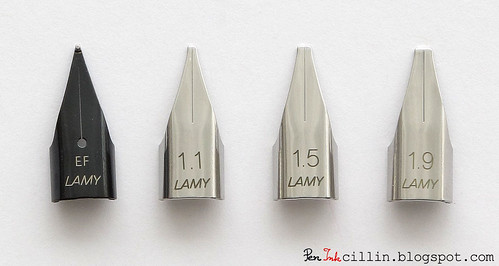
The cool thing about Lamy fountain pens is that many of the different models share the same type of nib. Among them, I would list the Lamy AL-Star, Vista, Safari, Joy, CP1, Logo, Pur, Studio and Accent. Whew, that's a lot of them! Sharing is good, but being able to swap nibs on the go is even better.

Changing the nib on one of these models is a piece of cake. The nib lies on the feed on a type of "rail". It slides on or off easily. Initially you might need to use the "scotch tape" method to remove the nib, meaning that you will stick a piece of tape to the nib and then pull it out by the tape. Brian Goulet has a great video explaining this very concept:


I have found that after you've swapped the nib a few times, the feed becomes less reluctant and allows you to remove the nib with your bare fingers. That's how I do it these days.

I bought my Lamy AL-Star with an EF nib but I really wanted to try their italic nibs so I bought the trio of italics in 1.1mm, 1.5mm and 1.9mm. Because these nibs are not exactly cheap I wanted to find the best deal on the web. At the time, my favorite store (no affiliation, just a satisfied customer, yada yada) didn't sell Lamy stuff so I found a UK company, The Writing Desk (no affiliation) which sold these nibs for a very good price. Including shipping, they cost less than what I would have paid here in the US.

Lamy nibs EF, 1.1mm, 1.5mm, 1.9mm


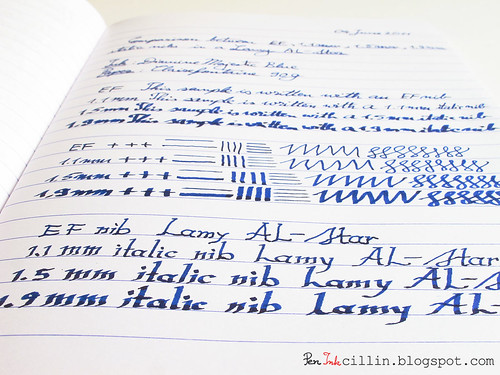
Anyhow, while the Lamy italic nibs are fun to use, I don't find myself using them a great deal but that's simply because I don't use my pens a lot these days. Here are some quick impressions on each of them. For this comparison I used Diamine Majestic Blue ink.

1.1mm italic
This nib is perhaps the easiest italic to get started with when you are lacking experience. Line variation is at a minimum and you can easily use this nib on a day-to-day basis.

1.5mm italic
Now you can start seeing some actual line variation. It becomes evident that an italic nib is used. This is perhaps my favorite size because it's neither too wide nor too narrow.

1.9mm italic
The biggest size is harder to use for quick writing so maybe it should be delegated to calligraphy duty. I found that, while all nibs flow really well, the 1.9mm needs to be held in good contact with the paper or else it can skip a little.

Lamy nibs EF, 1.1mm, 1.5mm, 1.9mm comparison


In summary, while I enjoy the 1.5mm the most for its mid-range variation, the 1.1mm is the easiest to write with, while the 1.9mm is more situational and is best used for calligraphy. With all italics I try to hold the nib at a 45 degree angle to the direction of writing. That seems to produce the best results.

One other thing that I have noticed is that italic nibs seem to make your handwriting look better. I have always written in cursive because that's how I was raised but my handwriting isn't the prettiest. Still, using an italic nib gives it a certain degree of polish, I would say. What do you think?

Lamy nibs EF, 1.1mm, 1.5mm, 1.9mm comparison

Sunday, September 25, 2011

Tragedy strikes my Lamy

Just a quick post to lament the loss of my Lamy's EF nib. Today, tragedy struck as I was cleaning my Lamy AL-Star. As I held the pen over the sink, I stupidly pulled the nib, dropped it into the drain and lost it forever.

I did try to fish it out of the drain with a powerful magnet tied to a string but good luck with that. These nibs seem to have pitifully little magnetic material in their composition. Short of dismantling the drain (which I'm not prepared to do), there's nothing else I could think of. So RIP dear EF nib.

It's been a short (but good) run for this nib, despite the problems I initially had with it. I ended up liking the EF nib very much but now it's gone and I won't see it again *sob*.

I can still use my Lamy fountain pen though: I've got my italic nibs which I also like a lot. So... life goes on!

Update: thanks to Tom Lynch's comment I thought I'd have another look at the pipes under my sink. Sure enough, I discovered something I missed the first time: there's a U-pipe there (the trap) which is held by 2 nuts. So I unscrewed those and out came the nib! Tragedy reversed! Thanks Tom!

Tuesday, February 22, 2011

Lamy AL-Star fountain pen review

The Lamy AL-Star fountain pen was my first of two pens, along with the Pilot Prera I reviewed a while back. I got the aluminum version, with an EF (Extra Fine) nib. I went for the EF nib because I knew European nibs were at least one size larger than their Japanese equivalent.

Note:  Note Booker, Esq pointed out in the comments that all AL-Star Lamys are made from aluminum. He's right but when I mentioned that I got the aluminum version I was referring to the finish of the pen, not the material from which it is made.

This particular Lamy proved to be not only one of the most expensive pens in my small collection but also the most obnoxious. My woes with this pen are documented here. In short, the AL-Star was almost DOA. It wrote poorly with the included blue cartridge but when I switched to the converter and various other inks, it went from poor to unusable. Luckily, I managed to fix it somehow though at this point I'm still not 100% sure how I did it. In any case, you can read about it by following the post I just linked.

Lamy AL-Star fountain pen

After going through all that trouble with the AL-Star, I swore I wouldn't buy another Lamy product in my life. Now, I am tempted to buy a few more. Indeed, it looks like I was one of the very few who experienced these issues and Lamy fountain pens have a very large following.

Speaking of the Lamy family and its fans, the AL-Star is identical to the Vista and Safari lines, except for the fact that the barrel and cap are made from aluminum. Hence the AL-Star designation. Now the fans, they are a crazy bunch. Some have collected every single Safari, Vista and AL-Star pen ever produced. Others like to collect all the colors. And who can blame them? These German-made fountain pens have a great looking industrial design that is practically ageless, not to mention trendy. The geometric angles are modern looking and instantly make the pen recognizable. The etched "LAMY" logo on the barrel contributes to this even more.

If there's one thing I like most about the Lamy AL-Star is the quality of the construction and the materials used. The satin aluminum body feels very nice to the touch although, truth be told, the material is a bit thin. But this also makes the pen lighter than it's size would indicate.

Lamy AL-Star fountain pen

This line of Lamy fountain pens is known for its hefty appearance and this is true for both length and girth, yet it makes for a comfortable writing experience. Thanks to its length and thickness, I don't feel the need to post the cap while writing. The Lamy used to be my biggest pen but it is now slightly dwarfed by the TWSBI Diamond 530.

Some may disagree but I find the triangular-shaped section very ergonomic. It helps the fingers grip the section securely and there is no way in which it could slip while holding.

Lamy AL-Star fountain pen

The AL-Star with the aluminum body comes standard with a blue ink cartridge but I also bought the Z24 converter because, well, I like to use my own inks. This is where the pen gets a negative mark. I don't understand why this type of pen doesn't come with a converter as standard. It's probably so that the manufacturer can milk the customer for some extra cash.

Lamy AL-Star fountain pen

Two other thing I would like to mention before moving on to the writing experience.

First, notice the ink viewing window that's carved in the barrel. It works pretty well for what it's intended: to show the ink level. With a bright ink such as the Diamine Orange, which was loaded in it when I took the pictures, it looks pretty cool.

Second, the clip may look funky to some but I like it. It's certainly the most interesting clip in my collection but I think it works very well with the modern design of the Lamy AL-Star. I haven't used the clip yet and I doubt I ever will since my fountain pens don't leave my home desk. The cap itself is a snap-on type and it shuts with a tiny click which, although secure, could stand to gain more firmness. As I mentioned before, the cap posts firmly but I never post it because the pen is long and heavy enough that I don't need to.

My AL-Star has an EF (Extra Fine) nib, colored in black. I would have preferred a silver nib to go with the aluminum body but I guess the black one matches the dark section. (By the way, the section itself is transparent, though smoky colored).

At present, the AL-Star is loaded with Diamine Orange which I just reviewed a few days ago. I loaded the ink into the old blue cartridge (which was of course cleaned) with the help of a syringe. I didn't use the converter because I wanted to see if the pen wrote better with the cartridge.

Lamy AL-Star fountain pen

I'm afraid I can't be very accurate in my assessment of the EF nib and that's because in my attempts to get the pen working, I tried widening the spacing between the tines. In the process, I believe that the EF nib has become at least a size larger. In the end, it doesn't really matter because the pen now writes like a champ.

Yes, whatever I did, it worked. The DOA Lamy AL-Star writes butter-smooth and I can confidently say that it is smoother than the Pilot Prera which was the former smoothness champion. All this with the caveat that it uses Diamine Orange and the nib is thicker than the Japanese M nib.

After I finish this load of Diamine Orange, I will be testing other inks to see how well they perform in the AL-Star. All three Noodler's inks (Gruene Cactus Eel, Heart of Darkness and Navajo Turquoise) I tried in it prior to adjusting the nib failed to write. I intend to switch back to some type of Noodler's ink to see if the ink brand really makes a difference.

One other feature I really like in this family of Lamy fountain pens is the fact that the nibs can be easily swapped for other types. Lamy makes a variety of nib sizes including EF, F, M, B, LH (Left Handed) and a few others. But some of the most exciting ones are the italic calligraphy nibs in 1.1mm, 1.5mm and 1.9mm sizes.

It so happens that after I fixed my Lamy, I craved an italic nib so badly that I ordered all 3 sizes. Here's where the versatility of this pen comes into effect. The nib is so easy to swap, that you can do it with your bare hand, or rather the tips of your fingers. Or you can use your nails to pull the nib out. Or, if it hasn't been swapped before and it's a little tight, you could use a little sticky tape to help you pull it out.

And all this can be done on the fly. I tested all three italic nibs as soon as I got them, one after the other, with the pen loaded with ink. So with a single fountain pen you can pretty much write in as many different styles as you have nibs. Amazing! You can consider the Lamy a dip pen: the fountain pen itself is the nib holder and you can swap nibs at will.

A review of the three italic nibs will come later. For now, I am concentrating solely on the stock Lamy AL-Star.

As far as ink flow is concerned, there's nothing I can find fault with. The ink flows smoothly and consistently and the pen starts right away, even though I store it with the nib pointing up. I use the Lamy almost exclusively for drawing and the lightest touch on paper makes the ink flow.

Finally, there isn't much else to say about the writing experience except what I already mentioned: now that it's fixed, it writes incredibly smooth. You can check out the two writing samples I used for reviewing the Diamine Orange ink. Notice that there is no skipping whatsoever, but the line width seems thicker than what one might expect from an EF.

So there you have it: yet another favorable review of the Lamy AL-Star, with the mention that, had it worked perfectly from the beginning, I would have loved it even more. I guess that's the price you pay for mass-manufactured and inexpensive goods: lackluster quality control.

Diamine Orange ink review on photocopier paper

Diamine Orange ink review on Staples journal

Saturday, February 5, 2011

How to revive a dead Lamy AL-Star

Among the goodies I got with my first Jetpens purchase, the Lamy AL-Star in aluminum with an EF nib was a top contender toward becoming my main fountain pen. Alas, it turned out I received a dud. The pen was close to being DOA.

The pen came with a blue Lamy ink cartridge but I also bought a Z24 converter to use with bottled ink after the cartridge ran out.

As soon as I started using the AL-Star, I realized that I was having problems. The pen showed several symptoms. The line was faint but I assumed that came from the Lamy ink which wasn't very saturated. The nib skipped a lot and usually it was scratchy. The flow would stop for long periods of time after which it would resume after much coaxing. It would write "normally", but not very satisfyingly, and then it would stop again without warning.

I attributed all my woes to the Lamy ink and cartridge. I told myself that once I'm done with that cartridge I can switch to Noodler's Heart of Darkness (which was the ink I intended to use in this pen) and everything would be ok. I was wrong. My troubles had only started.

In what follows is a list of things I did in order to get this pen working.

Lamy AL-Star disassembled

1) After finishing the Lamy cartridge, I flushed both the pen and converter (although I hadn't used the converter yet) with water and a couple of drops of dish washing liquid. I then flushed them all multiple times with just water.

2) I loaded up the pen with Noodler's Heart of Darkness ink. The problem immediately got worse. I managed to get the ink flowing but the line was very faint and scratchy despite the fact that this ink is usually very dark and saturated so it was clear something was very wrong with the flow.

3) I thought maybe the pen didn't like the ink so I tried 2 more inks in it: Noodler's Navajo Turquoise and Noodler's Gruene Cactus Eel which is a lubricating ink. Neither worked. I started to despair and almost gave up on the pen.

4) I decided to try one final ink in it: Diamine Orange.

5) I also decided to use the ink cartridge I had saved, loaded with Diamine Orange via a syringe because I'd heard that sometimes cartridges provide a better flow than converters.

6) At the same time I took a closer look at the EF nib and noticed that the tines were touching. Holding it to the light showed no light shining through. I used a piece of 35mm film, pulling it multiple times between the tines, in an attempt to create some space between them. I started from the breathing hole and forced the film along the length of the tines, toward the tip. I also tried to do the same with an exacto knife but I wasn't very successful because the blade is comparatively thick compared to the space between the tines. Eventually I reached a point where I could discern light between the tines.

Having done all this, I loaded up the pen with the cartridge containing Diamine Orange and lo and behold, it started writing! Not only did it start but it now writes very smoothly and, dare I say, wetly. The ink flow is excellent and I even get the impression that it's smoother than my Pilot Prera.

Wow what a difference! The only beef I have now with the Lamy is that (perhaps as a result of spacing out the tines) it writes far from EF. Compared with a Japanese nib I'd hazard to guess that it feels more like a B or BB. But hey, it writes and I was almost prepared to chuck it in the trash.

So which of the above methods did the trick? It's hard to pinpoint but I think 4, 5 and 6 all might have contributed to an extent. It is possible that the Lamy doesn't like Noodler's ink but other people are using this ink in it with success. It is also possible that the converter sucks for some reason but then what is the point of having a converter?

Until I test the AL-Star with a different ink plus the converter, I will put my money on the nib. Because the tines were touching I believe the flow of the ink was severely restricted.

I've heard of other people having issues with their Lamys (AL-Star, Safari, Vista or Joy). If you do happen to experience a similar problem, I suggest you try some or all of my steps but just to save you time, I'd start with taking a look at the nib and spreading the tines a little if there's no light shining through. And if you're successful in fixing it, please drop me a line here.

Wednesday, January 26, 2011

1st Jetpens haul

JetPens was the store that started the pen & ink craziness for me. I came across them on an un-related site that I read regularly and the author of the article was fascinated by the multitude of Japanese stuff carried by them.

I started browsing the site and was also amazed at the wonderful stationery products the Japanese make. After reading many reviews and checking the dozens of pen and ink specs on the site, I placed the following order and received my first Jetpens haul. This was last year in December but I feel like I have to talk about it since I just started this blog.

1st Jetpens haul


Moving from left to right, I have the following:

Pilot Prera fountain pen, yellow body and M (medium) nib.
Pilot CON-50 piston converter for the Prera.

Lamy AL Star fountain pen, aluminum body and EF (extra fine) nib.
Lamy Z 24 piston converter for the above.

Noodler's Apache Turquoise ink, 3oz bottle.
Noodler's Heart of Darkness ink, 4.5oz bottle. Not pictured is the free Platinum Preppy pen that Noodler is including with all 4.5oz bottles.

Finally, a bunch of Platinum Preppy fountain pens in various colors: violet, yellow and green. The yellow has a fine nib while the others are medium.

If you're wondering at the yellow Pilot, I decided that I really liked how this color looked in photos and I wanted to use it with an equally bright ink so that's why I got the Noodler's Navajo Turquoise. Yeah, I know, crazy combination. On the other hand, I thought the black ink should match the Lamy well.

This was just an outline of my first significant purchase of pens and inks but I will be reviewing all the above as soon as time permits. Stay tuned!