If you've read my review of Noodler's Operation Overlord Orange and Burma Road Brown, you will know that I wasn't thrilled with either of those two inks. OOO is dull and bleeds hard through the paper (any paper), while BRB is dry and tends more towards green than khaki.
Luckily I just bought samples of these inks instead of full bottles. After reviewing and playing a little with them, I still found myself with a small amount. I wasn't going to throw it away so I decided to mix the remainder. I didn't know what to expect but I suspected that they would mix well, considering they belong to the same "family", namely Noodler's V-Mail.
I poured them into my Pilot Varsity and the result was more interesting (to me) than either of those two inks. I got a truer shade of khaki, lighter than Burma Road Brown, with hints of gold.
I can't tell what the exact proportions were but I would roughly estimate 5x OOO : 3x-4x BRB. There was slightly more Operation Overlord Orange, but Burma Road Brown, being darker, overcomes it, so the darker ink is more prominent.
In the Pilot Varsity it flowed really well. It also showed a little bit of shading. It managed to curb some of Operation Overlord's bleedthrough, though this one also bleeds through Rhodia a bit and a lot more through regular photocopier paper.
So there you have it: another successful ink mix!
Showing posts with label ink tips. Show all posts
Friday, August 5, 2011
Ink mix: Operation Overlord Orange + Burma Road Brown
Labels:
ink mix,
ink tips,
Noodler's ink
Monday, June 27, 2011
Pipettes for ink filling
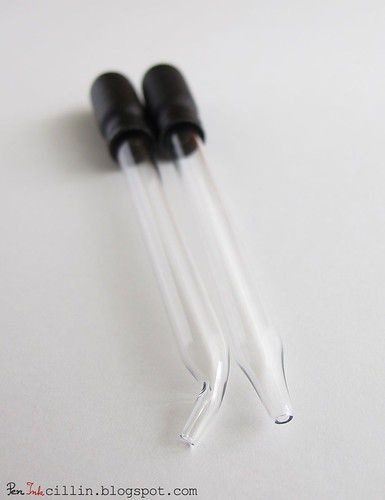
So I picked up a cheap set of pipettes from Walmart a couple of weeks ago. They were in the eye/ear section of the pharmacy. As soon as I laid my eyes on them I thought INK! I paid about $3 for them.
As you can see, one has a straight tip while the other is slightly bent. Though I would have preferred that both tips were straight, it turns out that I can still use the curved tip almost as well as the straight.
The reason why I like these little eyedroppers more than syringes is because they are made of glass and thus very easy to clean. The other nice thing is that the suction is very good for such a cheap eyedropper.
These are great for drawing ink out of sample vials. I use them to fill anything that can accommodate the tip. They work great with any of my eyedropper fountain pens. They work with Pilot cartridges because they have a wide opening. Unfortunately Lamy and international cartridges have a very narrow opening so I can only use the needle of a syringe to fill those.
One other way in which I use these pipettes is to fill a fountain pen via the feed saturation method. This works mostly for piston fillers such as my Noodler's flex.
I would really recommend these pipettes if you haven't found something more suitable for your ink filling needs. They are cheap and extremely easy to clean.
Labels:
ink tips
Monday, June 6, 2011
Noodler's Yellow and Navajo Turquoise ink mix
The proverbial ink wasn't even dry on my review of Noodler's Yellow, that I decided to, what the heck, give ink mixing a try.
Though this was my first attempt at ink mixing, I knew what I could expect. When mixing dyes, the four primary colors used are CMYK (Cyan, Magenta, Yellow and blacK). From these, almost any shade can be obtained. For lighter colors, white can also be used.
Noodler's Navajo Turquoise is an excellent substitute for Cyan and Noodler's Yellow is, well, Yellow. Cyan + Yellow gives Green. It depends, of course, what proportion of each primary color is used. Yellow being a light color, requires just a little bit of cyan to turn into green.
I still had some Noodler's Yellow left in the cartridge fitted to my Pilot Parallel 2.4mm. All I had to do was put a couple of small drops of Navajo Turquoise (of which I have a whole bottle) into the cartridge with a syringe and then shake it well until the two colors mixed. Since this wasn't a scientific experiment in the least, I have no idea what the exact proportions were, but if I were to guess, I'd say 4-5 parts of Yellow to 1 part of Cyan.
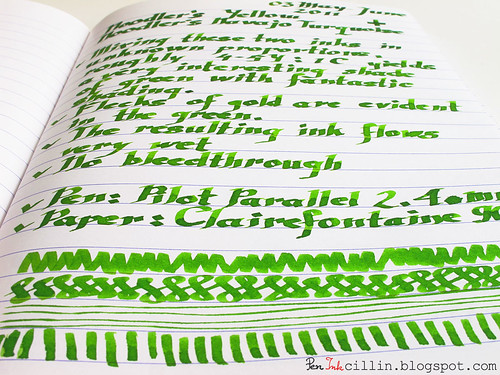
Here's the result: a very nice shade of light green, bright and saturated.
It looks like the inks didn't mix that well after all, but since I'm a beginner at this, it's hard to tell. This, however, creates a very beautiful effect. Notice the awesome shading: grass green interspersed with flecks of gold. To me, this color is very cheerful and refreshing. I would almost drink it from a frosty glass.
Here's a closeup of the beautiful shading.

This has been my first experiment with ink mixing but I consider it highly successful. What do you think?
Labels:
ink mix,
ink tips,
Noodler's ink
Subscribe to:
Posts (Atom)